
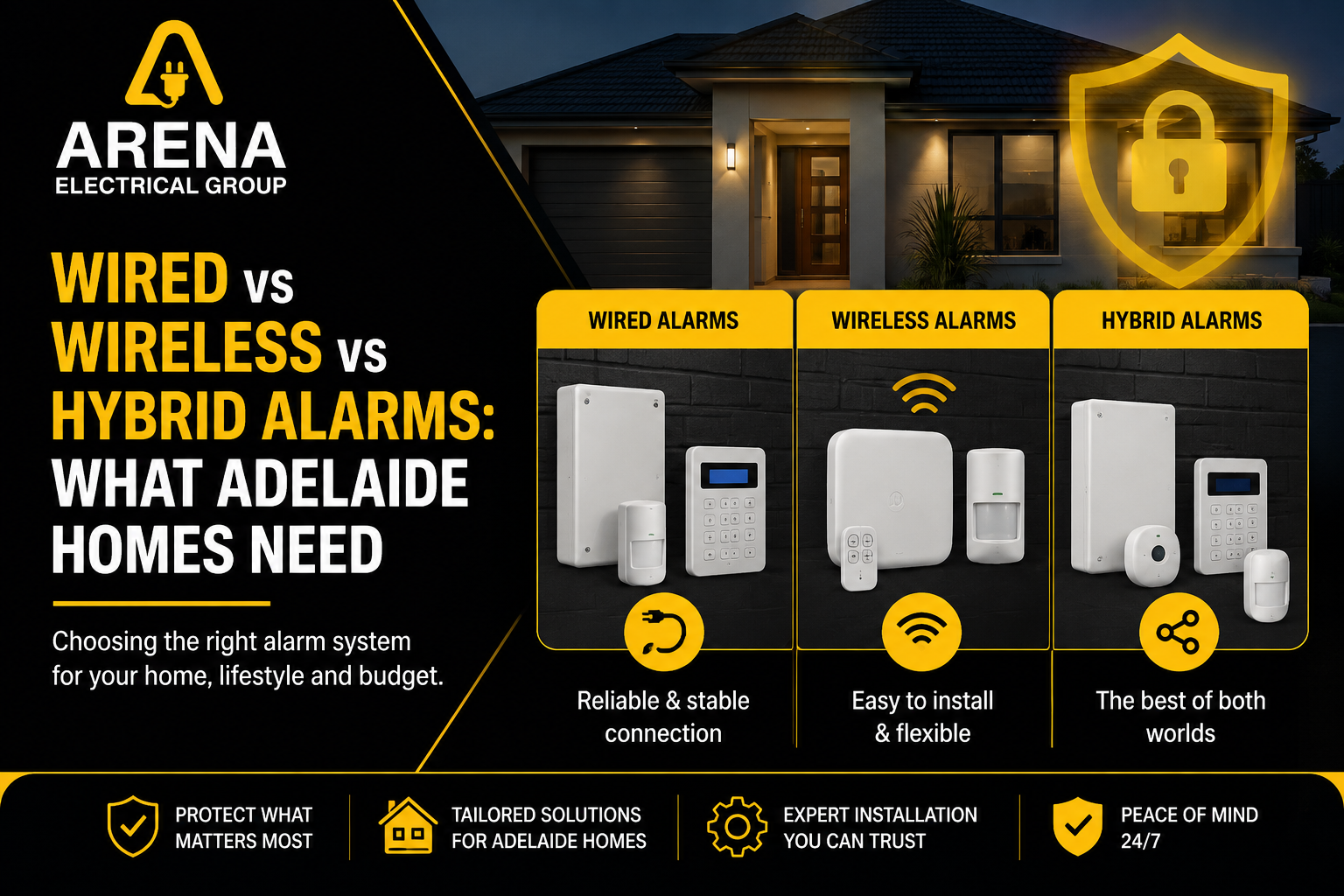
If you’ve been shopping around for a home alarm in Adelaide lately, you’ve probably noticed something confusing. One installer swears hardwired is the only “real” security system. The next one insists wireless is the future and anything else is outdated. And then, buried somewhere in the fine print, there’s a third option almost nobody explains properly: the hybrid alarm system.
At Arena Electrical Group, we install alarms across Woodville, the western suburbs, and the wider Adelaide metro every week. And here’s the honest truth from someone holding the drill: for most Adelaide homes built between 1920 and today, a hybrid setup is quietly outperforming both extremes. This guide breaks down why, what it actually costs, and whether it’s the right call for your place.
What Is a Hybrid Alarm System, Exactly?
A hybrid alarm system is a single control panel that supports both hardwired and wireless sensors simultaneously. The brain is the same. The keypad is the same. The monitoring is the same. The only real difference is how each sensor gets its message back to the panel.
On a typical Adelaide job, that plays out something like this. We’ll hardwire the sensors on your main doors, front windows, and the busy walk-through zones — anywhere we can pull a cable through the wall cavity without making a mess. Then we’ll go wireless for the awkward stuff: the garage, the granny flat, the shed down the back, an upstairs bedroom that got added later, or that one room where the plaster’s so old we’d rather not put a drill through it.
Most modern panels we install in Adelaide are built for this setup:
- Bosch Solution 3000
- Paradox Magellan
- Hikvision AX Hybrid Pro.
What’s the Difference Between Hardwired and Wireless Security Alarms?
This is the question we get asked most often on a first consult, so let’s settle it properly. Both systems detect the same things. The difference is entirely in how the sensor communicates with the panel, and that changes almost everything else about the install.
| Feature | Hardwired Alarm | Wireless Alarm | Hybrid Alarm |
| How sensors connect | Physical cable to panel | Radio signal to panel | Both, on one panel |
| Power source per sensor | Powered by panel | Battery (2–5 yrs) | Mix |
| Best for | New builds, exposed frames | Existing homes, rentals | Renovations, extensions, heritage |
| Signal reliability | Extremely high | High (can face interference) | High — critical zones stay wired |
| Battery maintenance | None for sensors | Every 2–5 years per sensor | Only for wireless zones |
| Install disruption | High (cable runs, chasing walls) | Low (mount and pair) | Medium |
| Install time (avg 4-bed home) | 2–3 days | 4–6 hours | 1–2 days |
| Hackability / signal jamming | Not possible remotely | Rare but technically possible | Wired zones protect the core |
| Expandable later | Difficult | Easy | Easy |
| Typical lifespan | 15–20+ years | 8–12 years | 15+ years (wired core) |
The short version: So here’s how it actually shakes out. Hardwired wins on reliability and lifespan-but retrofitting it into a home that’s already finished means chasing walls, patching plaster, and a bigger bill at the end. Wireless is the opposite: we can have it up and running in an afternoon, but every sensor runs on a battery you’ll be changing every few years, and the signal isn’t quite as bulletproof as a physical wire. Hybrid pulls the good stuff from both sides and skips most of the headaches.
Where Hybrid Actually Fits
Here’s how the three options stack up on the two variables that matter most to Adelaide homeowners: install disruption and long-term reliability.
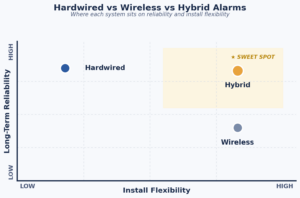
Note – Hybrid sits in the top-right sweet spot for a reason. You get hardwired-grade reliability on the sensors that matter most — front door, back door, main living area — without tearing up plaster in every room of a home you’ve already renovated.
Why Hybrid Suits Adelaide Homes Specifically
Adelaide has a housing mix most Australian cities don’t. Woodville, Prospect, Norwood, Unley, Glenelg — you’ll find 1920s bungalows sitting next to 1970s brick veneers sitting next to 2024 new builds, sometimes on the same street. That variety is exactly why one-size-fits-all alarm systems keep letting people down here.
- Heritage homes (pre-1960): Chasing cables through solid plaster or double-brick walls is destructive and often bumps into old knob-and-tube wiring we then have to work around. Hybrid lets us wire the front and back entrances properly and drop wireless PIRs into bedrooms and the lounge without touching a cornice.
- Post-war and 70s–90s brick veneers: Usually workable for hardwired, but if you’ve already renovated the kitchen or added a rear extension, hybrid lets us hardwire the original footprint and cover the new build with wireless.
- New builds and knock-down rebuilds: During the frame stage, hardwired everything is genuinely the right call — cable runs are free while the walls are open. We still install a hybrid-capable panel so the owner can add wireless sensors to a future pool house or shed without opening walls again.
- Sheds, granny flats, and detached garages: Almost always wireless. Running cable across a driveway is nobody’s idea of a good time.
When Hybrid Isn’t the Right Call
We’re not going to pretend hybrid is the answer for every home. There are two situations where we’ll steer you elsewhere:
- You’re renting — go wireless. There’s no point installing anything you can’t take with you.
- You’re building from scratch — go fully hardwired during the frame stage, then let us add wireless expansion capability to the panel for future add-ons. When the walls are open, cable is cheap. Once they’re closed, it isn’t.
For everyone in between — and that’s most of Adelaide — hybrid is the setup we install more than any other, and it’s the one we recommend to our own family members.
Ready to Talk About Your Home?
If you’re weighing up a security alarm installation for your Adelaide home and you’re not sure whether hardwired, wireless, or hybrid is right for you, we’re happy to have an honest conversation about it — no pressure to go one way or the other.
Arena Electrical Group installs security alarms, CCTV, and integrated hybrid systems across Woodville and the Adelaide metro area. We’re licensed electricians, which means we handle the wiring, the switchboard integration, and the alarm itself as one job rather than sending three different tradies to your door.
Not sure which alarm system suits your home?
Call us for a free on-site assessment. You’ll speak to a real Adelaide electrician, and we’ll come out for a proper look — no pressure, no vague quotes.