You’ve found the warehouse in Regency Park. The lease returns look decent, the building inspector gave the structure a tick, and the numbers stack up. Everything says go until three months after settlement, when the switchboard trips every second Tuesday and your tenant threatens to break the lease.
This happens more than most buyers realise. A standard building inspection covers the bones of a property, but the wiring behind the walls rarely gets more than a quick glance. That’s a problem, because faulty electrical installations are one of the leading causes of commercial fires in South Australia, and fixing legacy wiring after purchase can run into tens of thousands of dollars.
That’s why more Adelaide investors and business owners are booking a pre purchase electrical inspection before settlement. It’s a targeted check of the wiring, switchboard, distribution, earthing and safety systems by a licensed electrician, not a builder, not a valuer, not a pest inspector holding a torch. Done between contract signing and settlement, it’s the difference between buying a functional asset and inheriting somebody else’s problem in a metro market where commercial properties turn over fast.
What a commercial electrical inspection actually covers
There’s a fair bit of confusion between the electrical portion of a general building report and a proper commercial electrical inspection Adelaide sparkies carry out. A building inspector might tick a box saying “electrical appears functional”. A licensed electrician tests circuits, checks earthing, opens the switchboard, and measures whether the load capacity matches what the business actually needs.
Here’s what a typical inspection covers on a commercial site:
| Area inspected | What’s being checked | Why it matters |
|---|---|---|
| Main switchboard | Age, capacity, RCD protection, labelling | Older boards often don’t meet AS/NZS 3000 and struggle with modern loads |
| Circuit wiring | Insulation resistance, cable ratings, junction integrity | Aged or overloaded cables are the leading cause of commercial fires |
| Earthing system | Continuity, earth stake, bonding | Faulty earthing turns a small fault into a shock or fire risk |
| Sub-boards | Condition, breaker types, labelling | Poor sub-boards often signal cheap or unlicensed past work |
| Emergency & exit lighting | Battery health, illumination, discharge test | Legally required for most commercial premises in SA |
| Data & comms | Segregation from power cabling | Compliance and interference protection |
| Machinery connections | Three-phase supply, isolators, motor circuits | Confirms the site suits your intended business use |
| Compliance paperwork | Historical Certificates of Compliance (CoC) | Missing certificates suggest unlicensed work has been done |
Most inspectors also flag anything that looks like DIY work. Commercial properties bought and sold several times often accumulate a mix of legitimate installs and dodgy patch jobs from past tenants.
The cost of skipping it
Let’s talk numbers, because that’s usually where the decision gets made.
A pre-purchase electrical inspection for a small- to medium-sized commercial building in Adelaide typically costs between $450 and $900, depending on size, complexity, and whether three-phase machinery is involved. A small strip retail unit sits at the lower end. Warehouses with production lines cost more.
Now compare that inspection cost with what these visits tend to uncover:
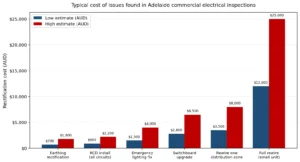
We have seen buyers walk into settlement with no clue their new property still has a 1980s switchboard that wouldn’t pass a modern insurance audit. The insurer finds out during a claim, and either reduces the payout or refuses it. Suddenly, a $600 electrical safety inspection would have paid for itself many times over.
What Adelaide’s building stock throws up
Adelaide’s commercial market is a mix. Mid-century industrial in Wingfield and Kilburn. Nineties office fitouts across the CBD. Newer developments in Mile End and Edwardstown. Each era comes with its own electrical quirks.
Buildings from the 60s through the 80s often still have their original switchboards. Ceramic fuses, no RCDs, aluminium wiring in some cases. The wiring itself might be sound, but the protection systems are decades behind current standards. Retrofitting can be done, but knowing about it before you sign is what matters.
Fitouts from the 90s and 2000s tend to have layers of modifications. Every tenant added a bit, extra data points, feature lighting, a split system in the manager’s office. Half of that work was likely done by licensed sparkies. The other half is anyone’s guess.
Newer stock isn’t automatically safe either. Poorly commissioned builds sometimes hide behind fresh paint. I’ve inspected properties less than five years old where the earthing was never properly bonded.
The inspection process and what to expect
If you’re organising a pre-purchase electrical inspection Adelaide-wide, here’s roughly how it plays out. The electrician needs access to the property with power on, ideally with the current owner or agent present. A basic inspection takes two to four hours for a small to medium site. Larger warehouses or multi-tenant buildings take a full day.
You’ll get a written report covering findings, photos of issues, rectification cost estimates, and a compliance summary. Some electricians break the report into “safety critical,” “compliance”, and “future consideration”. That framing is useful when you’re deciding whether to renegotiate the price.
That last point matters. An electrical safety inspection isn’t just about deciding whether to buy. It’s ammunition for the contract. If the report shows $15,000 of switchboard and earthing work, your solicitor can go back to the vendor for a price adjustment or vendor rectification before settlement.
| Buying without an inspection | Buying with an inspection |
|---|---|
| Unknown risks carried into settlement | Documented electrical condition on paper |
| No leverage in price negotiation | Written basis to request price adjustment or vendor repair |
| Insurance claims may be reduced later | Clear compliance picture upfront |
| Surprise costs weeks after settlement | Budgeted rectification plan before you sign |
| Possible disputes with tenants over faults | Confidence when leasing to commercial tenants |
Timing your inspection
The sweet spot is during your cooling-off period or as part of due diligence before contracts go unconditional. Book the inspection within a few days of your offer being accepted. Reports usually come back within 48 to 72 hours, which leaves time to raise issues before things firm up.
Waiting until after settlement to check the electrics is common and expensive. Once you own it, you own the problems. There’s no going back to the vendor.
Frequently asked questions
Q 1. Do I still need an electrical inspection if I already have a building and pest report?
Yes. Building and pest inspectors cover structure, damp, pests, and general condition — electrical systems sit outside their scope. A general building report might note “electrical appears operational,” but that’s a visual observation, not a test. It doesn’t cover insulation resistance, RCD trip times, earthing continuity, or whether the switchboard meets current standards. Only a licensed electrician can do that work and issue a report you can rely on for negotiation or insurance purposes.
Q 2. How long does a commercial electrical inspection in Adelaide take?
A commercial electrical inspection needs 2 to 3 hours for a small retail unit or office. For a warehouse with three-phase supply and machinery, half a day to a full day. Written reports usually land in your inbox within 48 hours.
Q 3. Will the vendor cover the cost of any problems found?
It’s a negotiation. If the inspection uncovers serious safety or compliance issues, most solicitors will use the report to push for price reductions or vendor-completed repairs before settlement. Having it in writing from a licensed electrician gives you proper leverage rather than a vague concern.
Q 4. Is a pre-purchase inspection the same as a compliance certificate?
No. A Certificate of Compliance is issued when new electrical work is completed. A pre-purchase inspection assesses the existing installation, including work that may have been done years or decades ago, some of which might never have been certified in the first place.